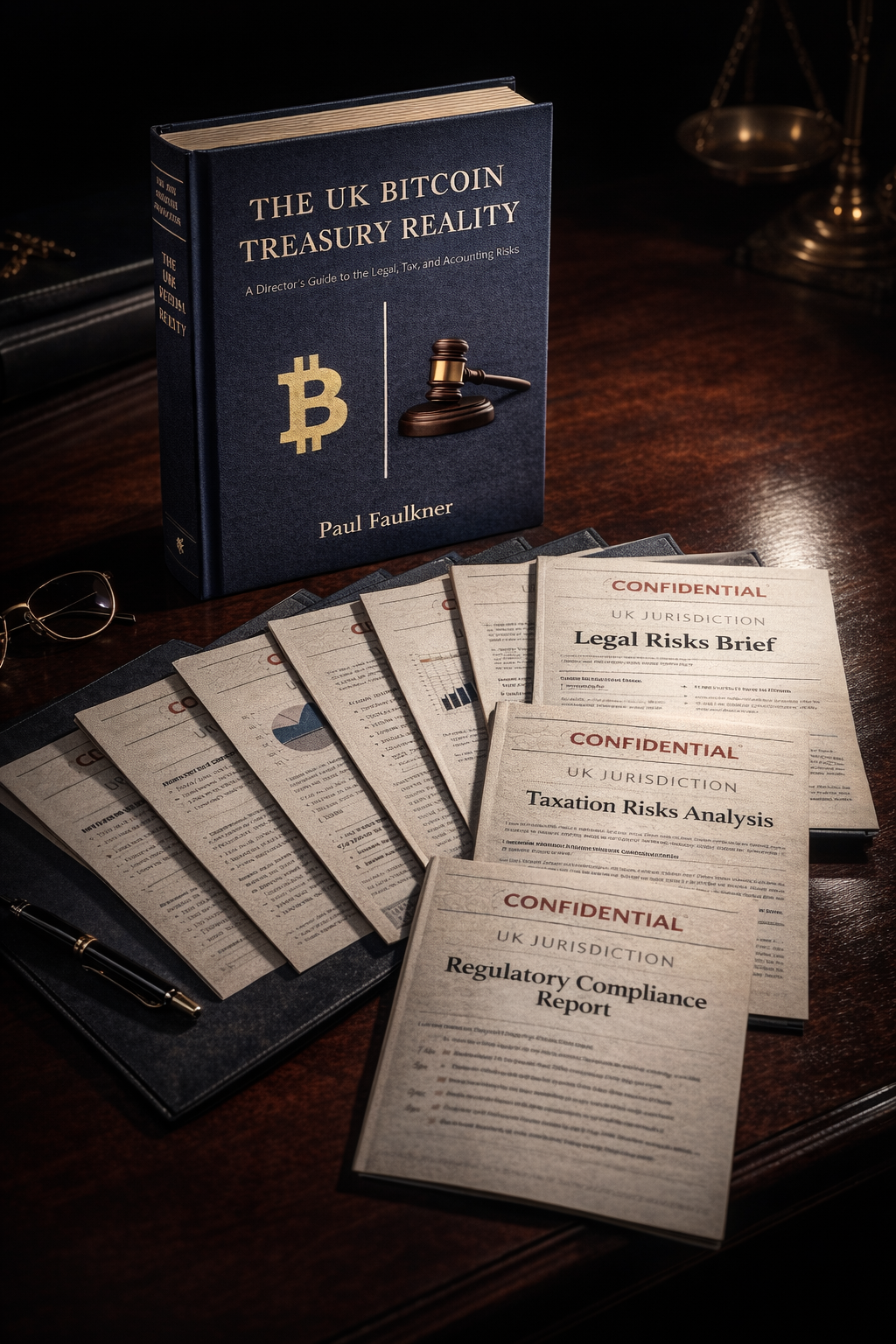
Bitcoin Treasury UK | The Legal & Accounting Reality for Directors | Paul Faulkner
New Edition — Available 1 May 2026 — Updated For The Evolving Landscape — £299
New edition launching 1 May 2026. Updated to reflect the evolving regulatory and legislative landscape. Sales paused until then. The updated Intelligence Pack will be available in 10 days.
New Edition — Available 1 May 2026
The UK Bitcoin Treasury Reality
The Strategy Inc. model requires four structural conditions to survive a bear market. None of them exist in the UK. The advisor who sold you this strategy didn’t mention that. This document maps what the UK legal and accounting framework actually does to the model — and what it means for you personally as a director.
The gap between the US model and the UK reality is not marginal. It is structural. Four separate pillars — accounting treatment, tax architecture, capital access, and regulatory framing — operate differently here. The sales process was not designed to surface any of them.
If your company subsequently cannot pay its creditors, the Companies Act does not ask whether you believed in the asset. It asks what professional advice you had on file when you made the decision. Most directors have none.
Forensic intelligence. Not investment advice, legal advice, or financial advice. All analysis derived from primary sources: statute, accounting standards, companies’ own public data.
0 of 4
Structural conditions that make the Strategy Inc. model survivable are present in the UK. You received the downside without the architecture that manages it.
£0
Unrealised gain that appears in your statutory accounts before disposal. Under FRS 102, every loss shows immediately and permanently reduces distributable reserves. Every gain is invisible until you sell.
4
Written professional opinions required before committing company cash to this asset class. Accountant. Solicitor. FCA-authorised advisor. Tax advisor. All independent. All crypto-neutral. Most directors have none on file.
70%
Bitcoin has fallen this far before. Your business needs to survive a drawdown of that scale without selling a single coin. If it cannot, the allocation is too large regardless of conviction.
Oct 2026
The FCA authorisation application deadline is October 2026. Firms that cannot or do not obtain authorisation must cease regulated cryptoasset activities by October 2027.
The advisor who sold you this strategy may not legally exist in its current form by the time your company needs to rely on the advice. The firm that ran the webinar, the “educational” session that moved you toward the allocation — none of that constitutes regulated advice. None of it protects you under the Companies Act.
This is a published government timeline with defined criminal consequences for non-compliant firms. It is not hypothetical risk. It is a countdown that started without your knowledge.
The Core Verdict
The asset may be sound. The advice is not. The law does not distinguish.
Directors who implemented strategies based on unregulated advice face personal statutory exposure under the Companies Act and the Insolvency Act — regardless of whether they believed in the asset. This document maps that exposure while there is still time to address it.
Free — Immediate Download
The Director’s Reality Check
14 binary questions across five risk areas. Every answer is Yes or No. Every No is a specific legal or financial exposure — not a worry to park, a statutory gap that requires professional attention. Three or more Nos means you are currently exposed under the Companies Act.
Five Risk Areas — What the Checklist Covers
Section 1 — The Accounting Position (FRS 102)How Bitcoin appears in your statutory accounts at year-end. What it does to your distributable reserves. What that means for dividends already paid.
Section 2 — Creditor & Bank CovenantsWhether your existing lending arrangements have clauses that a Bitcoin impairment could trigger — and whether you have reviewed them with this specific question in mind.
Section 3 — Operational ResilienceWhether the allocation is sized correctly relative to your actual working capital position — and whether you have a Board-approved protocol for what happens in a sustained drawdown.
Section 4 — Director Duties & Wrongful TradingWhether you can demonstrate your Section 172 and Section 174 duties under the Companies Act — and what the Insolvency Act requires of a reasonably diligent director in your position.
Section 5 — The Advisor’s PositionTwo questions you should ask before your next conversation with anyone who has advised on this. Both answers are material. The checklist tells you why and what to do with each response.
⚑14 questions · Score your exposure · Action protocol for every No · Immediate download
Get the Director’s Reality Check — Free
The complete 14-question checklist, the scoring protocol, and the action framework for each gap. Use it before your next board meeting, before your next purchase, or before you hand anything to your accountant or solicitor.
Free · Immediate · Forensic intelligence · Not investment, legal or financial advice
What the Sales Process Omitted
Five structural gaps. None of them disclosed.
01
Your accounts show every loss. They cannot show a single gain.
Under FRS 102, Bitcoin is an intangible asset measured at cost. Every impairment is recorded immediately — hitting your profit and loss, reducing distributable reserves, potentially making a previous dividend payment unlawful. A price recovery above cost creates no corresponding credit until disposal. The Strategy Inc. model works because US GAAP gives it the opposite treatment. You don’t have US GAAP. The detail of what this means for your specific accounts position is in the pack.
02
Every operational disposal creates a secondary liability.
Every Bitcoin sale by a UK company is a chargeable event at 25% corporation tax on the gain. The implications for routine business obligations — tax payments, supplier settlements, working capital draws — are specific, calculable, and were not surfaced in the sales process. The pack contains the full worked framework.
03
The advisor called it education to avoid being regulated.
FCA regulation attaches to investment advice and financial promotions. The advisory market reframes the sale as education specifically to stay outside that perimeter. That framing has consequences for your recourse, your protection, and your documented professional advice defence under the Companies Act. The regulatory position is mapped in detail in the pack.
04
You received the downside of the US model without the architecture that manages it.
Strategy Inc. operates with four structural conditions that make Bitcoin treasury survivable through a bear market. Each of those conditions is specific, documented, and absent from the UK environment. The pack maps all four pillar by pillar — what each one is, why it matters, and what its absence means for a UK company director.
05
The liability is personal. The advisor is not in the frame.
If your company subsequently cannot meet its obligations to creditors, the liquidator does not pursue the advisor. The Companies Act asks whether you exercised reasonable care and skill. The Insolvency Act asks whether you continued incurring liabilities after the point a reasonably diligent director should have recognised the risk. Neither asks what the advisor told you. The full personal liability map is in the pack.
Three Statutory Frameworks. One Director.
The exposure was created the day you decided.
FRS 102
The loss shows immediately. The gain never does.
Every impairment hits your P&L the moment it happens. A recovery above purchase price creates no corresponding credit until disposal. Your bank covenant, your dividend position, and your creditor obligations are all live against this number — right now.
Statute: FRS 102 Section 18 · Financial Reporting Council
CA 2006
Your duty is judged on what you had on file when you decided.
Section 172 requires you to act in good faith for the success of the company. Section 174 requires the standard of a reasonably diligent director. That standard requires independent written professional advice before a material allocation to a volatile asset. Not a webinar. Written advice. On file. Before the first purchase.
Statute: Companies Act 2006 ss.172, 174
IA 1986
The window to fix this closes when a liquidator walks in.
Section 214 allows a liquidator to pursue directors personally for losses incurred after the point a reasonably diligent director should have recognised insolvent liquidation was a realistic prospect. The time to obtain proper advice and close the gaps is now — while the company is solvent.
Statute: Insolvency Act 1986 s.214
The Single Most Important Sentence In This Book
A UK director who allocated working capital to Bitcoin on the basis of unregulated advice, without written independent professional guidance on the FRS 102 implications, the distributable reserves position, and their duties under the Companies Act, and whose company subsequently cannot meet its obligations to creditors, does not have a defence.
Not A Defence.
Bitcoin’s long-term performance
The Strategy Inc. thesis
The 16-year CAGR
The fact that inflation erodes cash
The asset may be sound. The advice is not. The law does not distinguish between them.
The Intelligence Pack
Every gap the checklist identifies has a document in here to close it.
The UK Bitcoin Treasury Reality
Complete Intelligence Pack · Paul Faulkner · The Rogue Protocol · New Edition May 2026
£299
Available 1 May 2026 · One payment · No subscription
—
The UK Bitcoin Treasury Reality — The BookThe complete forensic record. The Strategy Inc. model dissected pillar by pillar. Why none of its four structural conditions exist in the UK. How the sales process is constructed to avoid surfacing that gap. The full personal liability map under the Companies Act and Insolvency Act. The Director’s Reality Check. The map.
PDF
—
Director Briefing DeckFor your board meeting. 21 slides. What the US model actually is, why each of its four pillars is absent in the UK, what your accounts now show under FRS 102, your personal legal position under the Companies Act and Insolvency Act, and the seven binary conditions a legitimate allocation must meet. The document that demonstrates every director present has turned their mind to these questions.
PDF + PPTX
—
The Recursive Tax Trap — Mathematical Proof DeckFor your accountant. The worked calculation that proves why every operational Bitcoin disposal costs more than the face value of the obligation it was sold to meet. Place this in front of your accountant with one question: have you modelled this for our position?
PDF + PPTX
—
Professional Advisor Risk BriefingFor your accountant and solicitor. Opens with their exposure, not yours. Maps three categories of professional negligence, the minimum standard of care across all four advisor types, the mandatory written opinions framework, and the 70% drawdown stress test. Hand it to them directly before your next meeting.
PDF + PPTX
—
The UK Translation Failure DeckFor your solicitor’s advice letter or board pack. 17 slides. Pillar-by-pillar comparison of the US and UK frameworks — accounting, tax, capital structure, legal exposure. Designed to be extracted as a standalone exhibit.
PDF + PPTX
—
The Crypto-Neutral Advisor Vetting DeckFor the conversation before you engage anyone. 11 slides. The questions that determine whether your advisor is operating inside or outside the FCA regulatory perimeter — and whether they have a conflict of interest they have not disclosed. Every question the sales process was designed not to ask.
PDF + PPTX
—
Strategic Overview DeckFor anyone who needs to understand the position before reading the full book. 15 slides. The four structural pillars, the personal liability framework, and the minimum standard of care. The document that opens the conversation with your accountant, your solicitor, or your board without requiring them to read the book first.
PDF + PPTX
▶
60-Minute Forensic Audio BriefingNo Bitcoin basics. No introduction. Straight into the statutory accounts. All four structural pillars in forensic detail — then the full personal legal liability framework. The audio your solicitor and accountant can listen to on the way to your meeting. Boardroom-grade from the first minute.
M4A · 60 MIN
New Edition. Available 1 May 2026.
Updated for the evolving regulatory and legislative landscape. £299 · One payment · No subscription.
Stripe-secured payment · Immediate download on purchase Forensic intelligence. Not investment, legal, or financial advice.
Paul Faulkner
Forensic Intelligence Operator The Rogue Protocol · May 2026
2005: Identified systemic risk at Bradford & Bingley three years before the 2008 crisis
Former VP: JPMorgan Chase Global FX Treasury
Background: PwC · SG Kleinwort Hambros
Publisher: The Rogue Protocol — forensic intelligence on cryptocurrency markets and market microstructure
The Methodology
The Rogue Protocol applies a single standard to every analysis: would this survive cross-examination by a hostile Goldman Sachs risk committee? Four tests on every piece of work — disclosed conflicts, traceable methodology, stated assumptions, genuine engagement with the bear case.
The UK Bitcoin treasury analysis is an application of that methodology to a specific market failure: a strategy that was built for a different legal, accounting, and tax environment being sold into the UK without translation. The gaps are not matters of opinion. They are in the statute. The pack documents them with primary sources.
The Rogue Protocol has published structural analysis on live UK Bitcoin treasury vehicles in advance of market consensus, on multiple occasions. The calls are in the Substack archive. The methodology is in this book.
Published in Advance of Market Consensus
The framework has been tested in public. The results are in the archive.
The Rogue Protocol has published structural analysis on live UK Bitcoin treasury vehicles before the market arrived at the same conclusions. The analysis is on the Substack. The calls are documented. The methodology that produced them is the same one that built this book.
The pattern is consistent: A UK vehicle launches. The market prices it as a success story. The Rogue Protocol publishes the structural analysis — accounting asymmetry, legal framework, personal liability exposure. The market arrives at the same conclusion eventually. The archive shows the gap between publication and consensus. The framework finds it first because it starts with the statute, not the narrative.
If you want to see the methodology applied to specific live vehicles in real time, that is what the paid Substack is for. The book gives you the framework. The Substack shows you what it finds when it runs.
Who This Pack Serves
UK Company Directors
You were approached about putting company cash into Bitcoin. You may have done it. This document tells you what your accounts now show, what your personal legal position is, and what you need to do — specifically — to close the gaps. The Director’s Reality Check tells you exactly where you stand.
Accountants
Your client has Bitcoin on their balance sheet. You may not have been asked about it before they bought. The pack covers how UK accounting rules treat it at year-end, what it does to their distributable reserves and dividend position, and what you need to advise on now. The Professional Advisor Risk Briefing is designed to be used directly in client letters.
Solicitors
Your client is a director who allocated company cash to Bitcoin on the advice of someone who may not have been FCA-registered to give it. The pack maps their personal liability under the Companies Act and the Insolvency Act, and your professional exposure if you reviewed the transaction without raising these questions.
IFAs, Compliance & Policy
The financial promotion and arranging perimeter, the October 2026 FCA authorisation deadline, the Consumer Duty implications, and the gap between what the advisory market is doing and what the regulatory framework requires. Every claim sourced to primary statute and FCA instrument.
Common Objections
Addressed directly.
The FRS 102 problem is not about profitability — it’s about timing. A Bitcoin impairment charge hits your P&L immediately regardless of how profitable the rest of the business is. It reduces distributable reserves immediately. The question is not whether you are profitable. It is whether a price movement has already occurred that affects your reserves position — and whether any dividends paid since that movement are now legally sound.
Your accountant can sort it — once they have been asked the specific questions the pack maps. Most accountants have not been asked these questions by their clients because most clients don’t know to ask them. The Professional Advisor Risk Briefing in this pack is designed to be handed to your accountant directly. It opens with their exposure, not yours. It gives them the precise framework for the conversation.
The Director’s Reality Check defines the minimum standard that advice must have met — across all four required advisor types, in writing, independently, before the first purchase. A director who can answer Yes to every question in the checklist has met the standard. Most cannot. The checklist identifies exactly which gaps exist and what professional advice is required to close each one.
The Companies Act does not wait for Bitcoin to recover. Your director duties were assessed at the moment you made the decision — based on the quality of the professional advice you had on file at that time, not on what the asset subsequently did. The window to document proper process is open now, while the company is solvent. It closes when a liquidator is appointed.
One argument: the Strategy Inc. model requires four structural conditions that do not exist under UK law, UK accounting standards, or UK tax treatment. A UK director implementing that model without those structural conditions is taking on the risk without the architecture that makes it survivable. The book describes what proper implementation requires, what it costs, and what the legal exposure is if it is not in place. It does not say don’t do it. It says here is what doing it properly actually requires.
Two Products. Two Different Jobs.
The pack closes the gaps you have. The Substack finds the next one.
The £299 Intelligence Pack is the permanent forensic record. The book maps the four structural failures, documents your legal exposure under the Companies Act, and gives you the decks to take to your accountant, solicitor, and board. You buy it once. It closes the gaps that exist right now.
The Rogue Protocol paid Substack is the live feed. The methodology applied to live UK Bitcoin treasury vehicles in real time — before market consensus forms. Published in advance. Sourced to primary documents. The framework from this book running in the open.
The book tells you what the framework is. The Substack shows you what it finds when it runs.
Live vehicle analysisUK Bitcoin treasury vehicles examined on or before launch — before the market forms a consensus view. The calls are in the archive.
—
Regulatory perimeter trackingFCA enforcement signals, MLR developments, financial promotions perimeter cases — as they emerge, sourced to primary instruments
—
Accounting and tax updatesFRS 102 revisions, HMRC guidance changes, and their specific consequences for UK directors with Bitcoin on their balance sheet
—
Edition-change alertsNotification when regulatory or legal developments require the book’s framework to be updated
—
The calls before consensusThe methodology finds structural failures before the market prices them. The Substack is where that work is published.
Independence and Disclosure
No position. No commission. No affiliation.
Financial Independence
The author holds Bitcoin. This is disclosed directly because the book identifies undisclosed conflicts of interest as a component of the advisory model it critiques. The forensic analysis of the UK legal and accounting framework is independent of that position. The author holds no interest in any corporate entity referenced in the analysis.
Legal Review
The legal and regulatory analysis has been reviewed by a qualified General Counsel and compliance specialist with experience in FCA authorisation, AML frameworks, MLRO responsibilities, and multi-jurisdictional regulatory compliance.
Not Advice
This document is forensic intelligence. It is not investment advice, legal advice, tax advice, or financial advice. Readers should obtain independent professional advice specific to their circumstances before making any decisions.
The Intelligence Pack — £299 — New Edition 1 May 2026
The framework. The decks. The closed gaps.
The book documents what went wrong and why. The decks give you something to put in front of your accountant, your solicitor, and your board. Every gap the Director’s Reality Check identifies has a specific document in this pack designed to close it. New edition updated for the evolving landscape. Available 1 May 2026. One payment. Immediate download.
Stripe-secured · Immediate download on launch · One payment · No subscription
Forensic intelligence. Not investment advice, legal advice, tax advice, or financial advice. Readers should obtain independent professional advice specific to their circumstances before making any decisions.
A Note on Data Integrity
To ensure a high-impact and seamless experience, we use technologies to understand how you interact with this site. By proceeding, you're consenting to a private data agreement that allows for a flawless user experience.
Functional
Always active
The technical storage or access is strictly necessary for the legitimate purpose of enabling the use of a specific service explicitly requested by the subscriber or user, or for the sole purpose of carrying out the transmission of a communication over an electronic communications network.
Preferences
The technical storage or access is necessary for the legitimate purpose of storing preferences that are not requested by the subscriber or user.
Statistics
The technical storage or access that is used exclusively for statistical purposes.The technical storage or access that is used exclusively for anonymous statistical purposes. Without a subpoena, voluntary compliance on the part of your Internet Service Provider, or additional records from a third party, information stored or retrieved for this purpose alone cannot usually be used to identify you.
Marketing
The technical storage or access is required to create user profiles to send advertising, or to track the user on a website or across several websites for similar marketing purposes.