Before any analysis, the claim must stand verbatim. The post in its original form, exactly as it circulates. The meme image is reproduced below as Exhibit A — the forensic subject of this report.
Exhibit A — Original Meme · Forensic Archive · paulfaulkner.com · May 2026
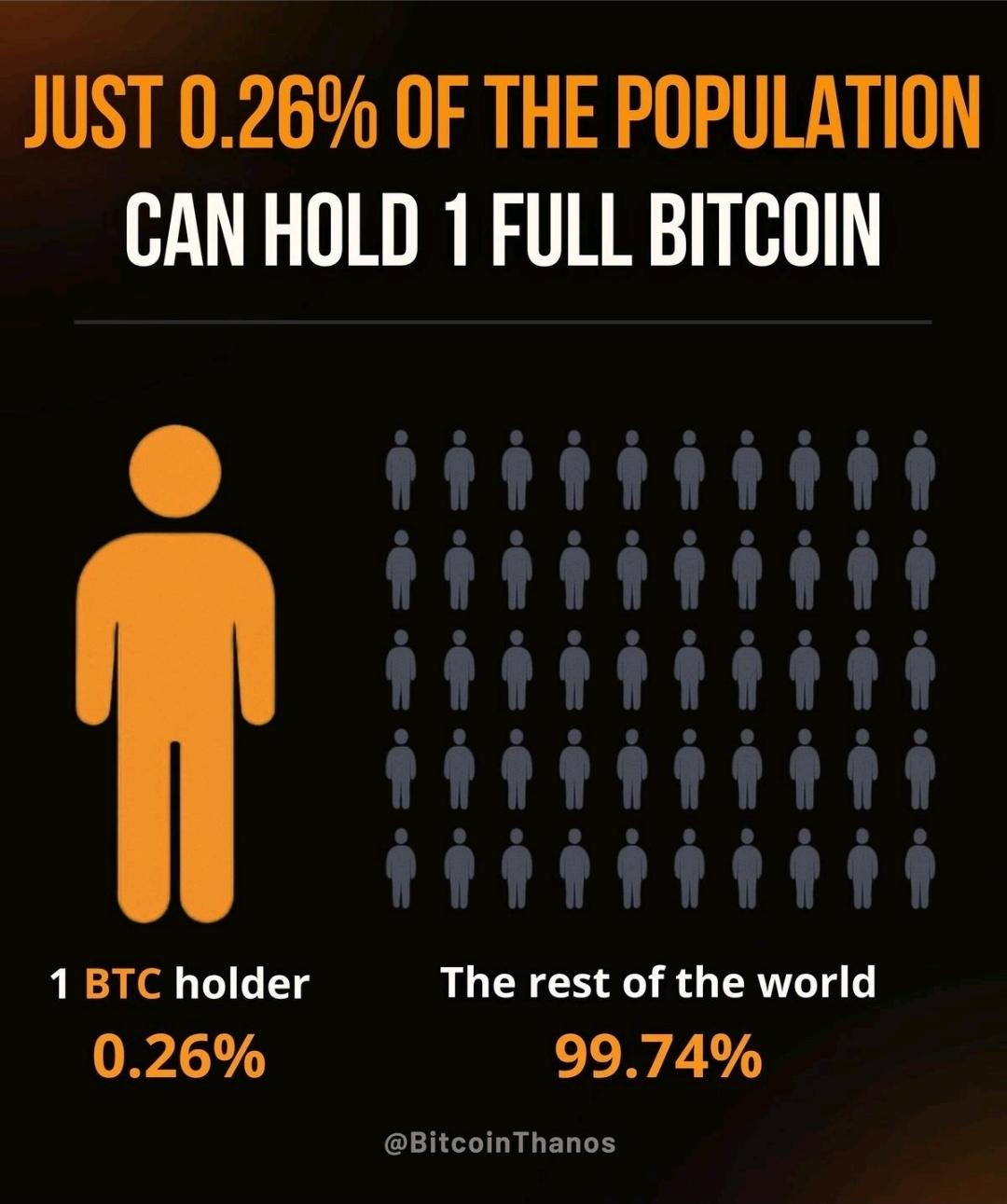
LinkedIn post · May 2026
ONLY 0.26% OF THE WORLD CAN EVER OWN 1 FULL BITCOIN. LET THAT SINK IN.
Most people still think Bitcoin is “too late.” But scarcity is the entire point. There will only ever be 21 million BTC.
Institutions are buying. ETFs are absorbing supply. Public companies are stacking. Governments are paying attention.
Meanwhile, billions of people still have zero exposure. The interesting part isn’t the current price. It’s realizing how few people can actually own a meaningful piece of the network if global adoption keeps accelerating.
Scarcity changes everything.
The Rogue Protocol · Initial Assessment
This post contains fourteen distinct errors before the arithmetic survives first contact
Tautological construction. Wrong supply denominator. Wrong population denominator. Contradictory Satoshi treatment. Self-defeating institutional absorption argument. Missing lost coin deduction. Fixed supply conflated with economic scarcity. No temporal demand argument. No substitutability acknowledgement. Source conflict undisclosed. We address each in order.
Figure 1 — Ownership Probability: The 0.26% Claim at Each Correction Step
Source: Bitbo, Chainalysis, iShares, Strategy Q1 2026, Glassnode, River.com, Worldometer · May 12, 2026
Strategy Inc. Alone — Under Hyperbitcoinisation
$19.5T
818,869 BTC × $0.2381/sat (financial assets scenario) = $19.5 trillion.
One company. Eighteen months of US GDP.
Under the scenario being sold as a democratising monetary revolution.
Average Sats Stacker — Under Hyperbitcoinisation
$11.91
50,000 satoshis × $0.2381/sat = $11.91.
The sats stacker recruited by the 0.26% post.
“Let that sink in.”
Figure 2 — Where the 20 Million BTC Actually Sits · May 2026
Source: Bitbo, Chainalysis, iShares, Strategy Q1 2026, River.com · May 12, 2026
Section Zero · Before the Analysis Begins
The Tautology
Before examining methodology, the headline number deserves one calculation — the multiplication the post implies but never shows. Run it and the magic dissolves immediately.
Post’s stated percentage
0.26% = 0.0026
Post’s implicit population
≈ 8,100,000,000
Number of people implied
8,100,000,000 × 0.0026 = 21,060,000 people
Bitcoin protocol hard cap
21,000,000 BTC
Difference
60,000 — a rounding artefact. The rest is tautology.
“The post divided the coin supply by the global population, converted the result to a percentage, and presented the quotient as insight. If there are 21 million of something, then 21 million people can each have one. That is the entire claim. That is what thousands of reposts are celebrating.”
The Rogue Protocol · Forensic Assessment · May 2026
The Tautology
The post divided a number by itself and called it scarcity
The trick works because the post buries both variables in percentage form. State it plainly: if there are 21 million of something, then 21 million people can each have one. That is not a revelation about scarcity. It is a definition. It contains no information beyond the supply figure itself. The post is tautology dressed as mathematics. And both its variables are also wrong.
Both Variables Are Wrong — In The Same Direction
Post’s supply figure
21,000,000 BTC
Protocol ceiling. 971,588 of these coins do not exist yet. Scheduled across 114 years of future mining. Cannot be purchased. Not relevant to a current ownership calculation.
Post’s population figure
~8,100,000,000
Verified global population as of May 12, 2026: 8,300,678,395. The post understated the denominator by over 200 million — compounding the numerator error in the same direction.
Post’s calculation (both variables wrong)
21,000,000 ÷ 8,100,000,000 = 0.259%
Step Zero correction (circulating supply · correct population)
20,028,412 ÷ 8,300,678,395 = 0.241%
Error before any forensic deduction
7% reduction from correcting inputs alone. The headline is wrong before the analysis starts.
Section I · The Satoshi Allocation
What 0.26% Actually Means: The Satoshi Allocation
The post frames the 0.26% as a statement about whole-coin ownership. It never asks the question the data actually answers. If Bitcoin’s entire supply were distributed equally across every person on Earth — what would each individual receive, not in Bitcoin, but in satoshis?
Total satoshis at protocol completion
21,000,000 × 100,000,000 = 2,100,000,000,000,000 sats
Equal share per person (8,300,678,395 people)
2,100,000,000,000,000 ÷ 8,300,678,395 = 252,994 satoshis
Value at $80,000 per Bitcoin
252,994 sats = $202.40 per person
Using post’s 21M figure
252,994 sats
21M BTC × 100M sats ÷ 8.3B people
= $202.40 per person at $80,000 BTC
Using corrected retail float
148,521 sats
12,328,412 BTC × 100M sats ÷ 8.3B people
= $118.82 per person at $80,000 BTC
Using liquid exchange supply
26,625 sats
2,210,000 BTC × 100M sats ÷ 8.3B people
= $21.30 per person at $80,000 BTC
The $202 Finding
The Bitcoin revolution, stated honestly, gives every person on Earth $202 — at current prices
Two hundred dollars. That is the ceiling of the egalitarian scenario — using the post’s own supply figure, distributed with perfect equality. Not at some future hyperbitcoinised price. At $80,000, today. The sats stacker being recruited by the 0.26% post is not being offered a meaningful stake in a monetary transformation. They are providing the capital that maintains the value of the holdings already controlled by the 2,035 whale addresses sitting on 35.5% of all supply. The actual distribution is documented in Section VIII. The per-person number under that distribution is not $202. It is much less.
Section II · Fixed Supply ≠ Scarcity
Fixed Supply ≠ Scarcity
The post’s closing line — “Scarcity changes everything” — is the argument’s load-bearing wall. Remove it and the entire structure collapses. The problem is that it conflates two categorically distinct concepts that the post treats as synonymous: a fixed issuance schedule and economic scarcity. They are not the same. One is a protocol rule. The other is a market condition. A protocol rule cannot guarantee a market condition.
What Bitcoin Actually Has
Fixed Supply
A hard cap of 21 million BTC, enforced by protocol consensus rules. No central authority can increase this. The issuance schedule is deterministic and public. This is a structural property of the software. It is real, verifiable, and permanent — assuming continued network consensus.
What the Post Claims Bitcoin Has
Economic Scarcity
An economic condition that exists when demand for a good exceeds its available supply at the prevailing price. Scarcity requires two inputs: limited supply AND sufficient demand. Fixed supply guarantees the first. It guarantees nothing about the second. The post presents fixed supply as if it automatically produces scarcity. It does not.
Counterexamples — Fixed Supply Without Scarcity
EXAMPLE 1
The 2000 Telephone Directory
A fixed print run. Finite copies. Permanently out of print. Not scarce — because nobody wants one. Fixed supply is a necessary condition for scarcity. It is not a sufficient one.
EXAMPLE 2
Tulip Bulbs, 1638
Scarce during the mania. Fixed per-season supply. Not scarce six months later — because demand collapsed. Scarcity is a dynamic condition. It requires demand to be sustained, not just present.
EXAMPLE 3
Abandoned ERC-20 Tokens
Thousands of tokens have hard caps. Immutable smart contracts. Genuinely finite supply. Their price is zero. Fixed supply without demand is not scarcity — it is inventory.
The Economic Definition the Post Ignores
Scarcity = a condition in which demand exceeds supply at the prevailing price, creating upward price pressure.
By this definition, Bitcoin’s scarcity must be empirically demonstrated — not assumed from a protocol rule. The test is the price and its direction. With exchange reserves at a 9-year low and 89% of supply locked, if scarcity were the dominant variable, the price would be substantially higher than $80,000 and rising. It is not. The market is in approximate equilibrium at $80,000 — which means supply and demand are roughly balanced at that level. That is not scarcity. That is a price.
The maximalist formula
Fixed Supply + Increasing Demand = Infinite Price
What is confirmed (May 2026)
Fixed Supply ✓ — provably true by protocol
What is not confirmed
Increasing Demand ✗ — volumes down 25–30% from 2025 peak
Result
$80,000 and declining from ATH — demand is the binding variable
“The 21 million cap is a ceiling, not a market outcome. At sufficient price, demand collapses regardless of supply. The post has conflated fixed issuance with permanent excess demand. Those are not the same thing — and the live price is the evidence.”
The Rogue Protocol · Forensic Assessment · May 2026
The Temporal Escape Hatch — And Why It Fails
The maximalist counterargument is that the thesis is a structural claim about the long run, not a snapshot of May 2026. “Fixed supply plus demand that arrives later still produces the thesis.” This is the most intellectually serious objection available. It must be addressed directly rather than dismissed.
The response requires one additional analytical move: distinguishing cyclical demand from compounding adoption. Bitcoin has produced four major price cycles — 2013, 2017, 2021, 2024/2025. Each attracted a new cohort of buyers. Each subsequently reversed. This is the pattern of cyclical demand — recurring but not cumulative past a structural floor.
The thesis requires a different pattern: compounding adoption that crosses an irreversible network-effects threshold, after which demand becomes self-sustaining and supply restriction produces permanent scarcity. That threshold has not been crossed. The evidence is the 2025 all-time high followed by a material drawdown on declining volumes — in a period when institutional infrastructure reached its maximum development. ETFs, corporate treasuries, sovereign reserves: all present. Price: below ATH. Volumes: falling.
Most powerful demand catalyst Bitcoin has ever seen
US spot ETFs + Strategy + sovereign reserves — all present by 2025
Result
Cyclical high → material drawdown → declining spot volumes
The question the temporal argument must answer
What catalyst remains that is larger than institutional maturation?
Substitutability — The Argument the Post Never Mentions
Bitcoin’s scarcity argument contains an implicit assumption that is never stated: that Bitcoin is irreplaceable for the function it claims to serve. Scarcity commands a premium only when the scarce thing is both limited in supply and irreplaceable in function. The supply constraint is real. The irreplaceability claim is not established.
Bitcoin’s Claimed Functions
Inflation hedge · Censorship-resistant transfer · Store of value · Speculative digital asset
Available Substitutes
Gold · Real estate · TIPS · Monero · Physical cash · Every hard asset with a multi-century track record · The broader cryptoasset market
Bitcoin has genuine advantages over each substitute in specific use cases. The question is not whether it is better in every dimension. The question is whether it is sufficiently better in enough dimensions to command a permanent scarcity premium over all substitutes simultaneously. That is an empirical question about adoption rates and use-case dominance — not a conclusion derivable from a supply cap.
The Foundational Error
Scarcity is an economic condition, not a protocol rule. Bitcoin has the first. It must earn the second.
The maxis have made a categorical error: mistaking a software property for a market outcome. The fixed supply cap is a necessary precondition for scarcity. It is not sufficient. The temporal argument — “demand arrives later” — requires compounding adoption, not cyclical demand. The substitutability gap means the scarcity premium is conditional on irreplaceability the protocol cannot guarantee. The actual bet being sold is: sustained, non-cyclical, adoption that crosses an irreversible threshold, with no substitute emerging to compete for the same function. That is a legitimate bet. It is not a mathematical certainty derivable from 21 million coins.
Section III · Error One
The Denominator Fallacy — Error One
The post uses 21 million as its numerator. This is the protocol cap — the ceiling — not the available supply. As of May 12, 2026, the circulating supply is 20,028,412 BTC. The post fails before a single further variable is considered.
What the post used
21,000,000 BTC
The protocol hard cap. Coins not yet mined included. This is a future theoretical ceiling, not a present supply figure.
What the post should have used
20,028,412 BTC
Actual circulating supply as of May 12, 2026. Block height 949,096. 95.37% of total cap already issued. Source: Bitbo.
Post’s calculation
21,000,000 ÷ 8,300,678,395 = 0.253%
Corrected Step 1 (circulating supply only)
20,028,412 ÷ 8,300,678,395 = 0.241%
Remaining ~971,588 BTC
scheduled for release over 114 years via mining
Error One
The post fails its own arithmetic before reaching any contested variable
The difference between 21 million and 20.03 million is not trivial — it is 971,588 BTC that does not exist yet, distributed across 114 years of future mining. Including unmined coins in a “who can own one” calculation is equivalent to counting unborn people in a housing availability study. The post has not yet begun its analysis, and it is already wrong.
Section IV · Error Two
The Satoshi Paradox — Error Two
Forensic on-chain analysis — specifically the identification of the “Patoshi Pattern” in early mining reward nonces — attributes approximately 1,100,000 BTC to Satoshi Nakamoto across roughly 20,000 addresses. These coins have not moved since 2010. Not once. The question of how they are treated reveals a logical trap that the scarcity narrative cannot escape.
✓ Included — when selling scarcity
When the 21 million cap is cited as proof of Bitcoin’s absolute scarcity, Satoshi’s 1,100,000 BTC are included in that total. The cap sounds scarce because those coins count. Remove them and the effective cap becomes approximately 20.03 million — a less dramatic number, producing a less dramatic post.
✗ Excluded — when calculating ownership odds
When the post calculates that “only 0.26% of the world can own a whole Bitcoin,” those same coins are implicitly treated as part of the available pool. The arithmetic only produces 0.26% if you divide by 21 million. If Satoshi’s coins are untouchable — which the same maximalists insist they are — they must be removed from the numerator entirely.
Logical Contradiction: The maximalist position requires including Satoshi’s coins in the cap to make scarcity sound absolute, and simultaneously treating those same coins as available supply when calculating ownership probability. You cannot do both in the same argument to the same audience. State your treatment. Defend it. They never have.
Circulating supply (Step 1)
20,028,412 BTC
Deduct: Satoshi’s dormant equity
– 1,100,000 BTC
Realized circulating supply (S_realized)
18,928,412 BTC
Recalculated ownership probability
18,928,412 ÷ 8,300,678,395 = 0.228%
“Satoshi’s coins are either part of the available supply — in which case they are not ‘proof’ of anything — or they are permanently withdrawn — in which case they must be deducted from the ownership calculation. The maximalist narrative requires both positions simultaneously, applied to the same 1,100,000 coins, in the same post, for the same audience.”
The Rogue Protocol · Forensic Assessment · May 2026
Section V · Error Three
The Institutional Absorption Trap
The post’s final paragraph is a celebration: “Institutions are buying. ETFs are absorbing supply. Public companies are stacking. Governments are paying attention.” This is stated as evidence of Bitcoin’s value. It is simultaneously the evidence that the 0.26% figure — already wrong — is shrinking in real time. Every inflow the post applauds removes coins from the denominator being sold to retail.
US Spot ETFs (Total)
~1,500,000 BTC
IBIT alone: 821,082 BTC as of May 11, 2026 — larger than Strategy. Absorbed since Jan 2024 launch.
~7.49% of circulating supply
Strategy Inc. (MSTR)
818,869 BTC
World’s largest corporate holder. “42/42” capital plan targets $84B in raises through 2027. Absorbs mining output at 2.8× rate.
~4.09% of circulating supply
Other Corporate Treasuries
~281,131 BTC
Marathon Digital, Metaplanet, Riot, Semler Scientific, and others. Total non-Strategy corporate: ~1.1M including Strategy.
~1.40% of circulating supply
Government Holdings
~500,000 BTC
US Strategic Reserve (est. ~198K), Bhutan (~12K), El Salvador (~6K), seized assets across jurisdictions. Source: River, Binance Square.
~2.50% of circulating supply
Total Institutional Removal
~3,100,000 BTC
US ETFs + all corporate treasuries + government holdings. ~15.5% of circulating supply removed from retail-accessible float.
The Contradiction
They cheered every one of these purchases
The IBIT inflow posts. The Saylor purchase announcements. Each one reduces the denominator they are using to sell the “0.26%” dream to the very audience reading their posts.
The Structural Contradiction
You cannot celebrate supply removal and simultaneously sell supply scarcity as the retail opportunity
The maximalist position requires two mutually exclusive propositions to be true for the same audience. Either institutional absorption is bullish for holders — in which case retail is being priced out by the very trend being sold to them — or the scarcity narrative applies to everyone equally — in which case the institutions are the competition, not the evidence. The post celebrates both simultaneously. It has no mechanism by which institutional “stacking” improves the retail ownership probability it is trying to advertise.
Section VI · Error Four
Forensic Decay
A portion of the circulating supply is not merely illiquid or “HODLed.” It is permanently inaccessible — private keys discarded, owners deceased without succession, coins sent to invalid burn addresses. Chainalysis and forensic firms estimate the range at 3 to 4 million BTC as of May 2026. The conservative figure — 3.5 million — must be deducted from any honest ownership calculation.
Conservative estimate
3,000,000 BTC
Lower bound of Chainalysis forensic range for confirmed-lost coins. Minimum defensible deduction.
Working estimate (this report)
3,500,000 BTC
Mid-range figure used throughout this report. Chainalysis cited. Challenged parties are welcome to produce a lower number with primary source citation.
Upper estimate
4,000,000 BTC
Upper bound of forensic range. If correct, the retail accessible float is smaller still than this report calculates.
Distinction from Satoshi
Lost coins are categorically different from dormant coins
Satoshi’s coins are technically mobile if the keys exist. Their treatment is a logical question. Lost coins are a mathematical certainty of permanent supply reduction — they cannot be accessed regardless of intent. Their deduction from the ownership calculation is not an assumption; it is a fact of the network’s current state. Leaving them in the denominator is equivalent to counting burned currency as circulating money supply.
Section VII · The Full Deduction
The Supply Stack
With all four deductions applied in sequence, the “retail accessible float” — the maximum amount of Bitcoin theoretically available to the 8.3 billion people on Earth to purchase as whole coins — can be calculated. Every figure below is sourced from primary on-chain data as of May 12, 2026.
Supply Deduction Waterfall
BTC · May 12, 2026
Circulating Supply (Starting Point)
20,028,412 BTC
100%
Less: Lost Coins (Chainalysis · conservative)
– 3,500,000 BTC
– 17.5%
Less: Global Spot ETFs (US + International)
– 1,500,000 BTC
– 7.5%
Less: Corporate Treasuries (all entities)
– 1,100,000 BTC
– 5.5%
Less: Satoshi’s Dormant Equity (Patoshi Pattern)
– 1,100,000 BTC
– 4.8%
Less: Sovereign Government Reserves
– 500,000 BTC
– 2.5%
Retail Accessible Float (May 2026)
12,328,412 BTC · 62.2% of circulating
Circulating Supply
20,028,412
Less: Lost Coins
– 3,500,000
Less: Global ETFs
– 1,500,000
Less: Corporate Treasuries
– 1,100,000
Less: Satoshi Dormant
– 1,100,000
Less: Sovereign Reserves
– 500,000
Retail Accessible Float
= 12,328,412 BTC
Corrected ownership probability
12,328,412 ÷ 8,300,678,395 = 0.148%
Post’s stated figure
0.253%
Overstatement
+70% above the corrected figure
Finding
The 0.26% figure is wrong by 69% before the most devastating variable is applied
With all four forensic deductions applied — lost coins, institutional absorption, Satoshi’s dormant equity, and sovereign holdings — the retail accessible float is 12.33 million BTC, not 21 million. The correct probability is 0.148%, not 0.26%. The post’s headline number is wrong by more than half — and we have not yet examined what is actually available to buy today.
Section VIII · The Kill Shot
The Liquid Float Paradox
The retail accessible float of 12.33 million BTC is itself a theoretical figure — it assumes all non-institutional, non-lost, non-Satoshi coins are equally available for purchase. They are not. As of May 2026, Bitcoin exchange reserves have fallen to approximately 2.21 million BTC — the lowest level in nearly a decade. This is the amount of Bitcoin actually available for immediate purchase on all major trading venues globally.
BTC on Exchanges
2,210,000
Total exchange reserves as of May 2026. 9-year low. Source: Glassnode.
% of Circulating Supply
~11.03%
89% of all circulating BTC is effectively off-market for immediate purchase.
24h Trading Volume
222,979 BTC
$17.91 billion. Down 25–30% from 2025 peak levels. Source: Bitbo.
Liquid Float Probability
0.027%
2,210,000 ÷ 8,300,678,395. The fraction of the world that could buy a whole coin from exchange supply today.
The Pricing Paradox
Supply restriction at historic maximum
→
price: $80,000
≠
scarcity-driven infinity
If supply is this restricted — 90% of all Bitcoin locked in long-term storage, institutional silos, Satoshi’s addresses, or lost forever — and exchange reserves are at a 9-year low, then the price of $80,000 is an indictment of demand, not a testament to scarcity.
In any other asset class, a 90% supply restriction with an 11% liquid float would produce parabolic price discovery if demand were truly limitless and global. Bitcoin is trading at $80,000 — a significant drawdown from its 2025 highs. This proves that demand is the binding variable, not supply. The scarcity is real. The demand is not.
The Kill Shot
“Scarcity changes everything” — but 90% locked only gets you $80,000
This is the question the post cannot answer: if the scarcity is as extreme as they claim — and the on-chain data confirms it is genuinely extreme — why is the price $80,000 and declining from highs? The maximalist arithmetic requires Fixed Supply + Increasing Demand = Infinite Price. The market is disconfirming the demand side of that equation in real time. The scarcity narrative has not failed to restrict supply. It has failed to create the perpetual demand surge that justifies the “get in before it’s too late” messaging aimed at retail.
Section IX · The Whole-Coiner Myth
Wallet Distribution
The audience being sold the “0.26% whole-coiner” dream is being offered an outcome that is already statistically improbable within the existing holder base. On-chain wallet distribution data from May 2026 reveals a concentration of Bitcoin wealth that matches or exceeds the inequality of traditional financial systems — the very systems the maximalist narrative claims Bitcoin disrupts.
Bitcoin Address Distribution · May 2026 · Source: BitInfoCharts
≥ 1,000 BTC (Whales)
2,035 addresses · 7,107,567 BTC
0.003% of all addresses hold 35.5% of all accessible supply. These are the people writing the posts about scarcity.
100 – 1,000 BTC (Major holders)
18,170 addresses · 5,238,097 BTC
Combined with whales: 0.033% of addresses hold 61.7% of supply.
10 – 100 BTC (Significant holders)
130,296 addresses · 4,232,470 BTC
The “10+ BTC” cohort entered before 2020. This outcome is not available to new retail participants at $80,000.
1 – 10 BTC (Whole-coiners)
824,839 addresses · 2,045,931 BTC
~950,000 addresses total hold ≥ 1 BTC. Many are exchange cold wallets, custodians, and small businesses — not individuals.
0.1 – 1 BTC (Fractional holders)
3,513,427 addresses · 1,073,198 BTC
The realistic ceiling for the majority of retail participants who entered after 2021.
< 0.1 BTC (Sats stackers)
~54,000,000 addresses · ~328,000 BTC
92.35% of all Bitcoin addresses. The audience being pitched the “whole-coiner” dream. Collectively they hold ~0.0016% of supply.
The Whole-Coiner Myth
Whole-coiner status is already a 1-in-500 outcome within the existing holder base
There are an estimated 480–500 million Bitcoin owners globally. Approximately 950,000 addresses hold 1 BTC or more. That is 0.2% of existing holders who have achieved “whole-coiner” status — and many of those addresses belong to institutions, exchanges, and businesses, not individuals.
For a sats stacker holding 0.01 BTC (worth roughly $800 at current prices) to become a whole-coiner, they would need to invest an additional $79,200 into an asset that has already delivered its most aggressive growth phases and is trading below its 2025 all-time high. The post sells whole-coiner status as the goal for the masses. The distribution data proves it is already the exclusive province of those who entered before 2017 or who possessed significant external wealth from the outset.
Section X · The Structural Reality
The Exit Liquidity Framework
The scarcity narrative serves a specific and identifiable tactical purpose for whale-tier holders. By promoting urgency through “only 0.26% can own one” messaging, large holders create the retail demand conditions required to exit their positions without collapsing the market. The post is not insight. It is positioning.
Whale Activity · Early 2026
Large-scale distribution while retail sentiment remains bullish
Analysis of on-chain whale activity reveals that addresses holding 1,000–10,000 BTC have reduced their collective holdings by approximately 220,000 BTC over the past year. Rallies toward the $82,000 level are consistently met with distribution from the 2025-peak cohort. The scarcity posts run hottest during these distribution windows.
The Incentive Structure
Who needs price appreciation — and who is providing it to them
The accounts publishing “0.26%” posts are not institutional analysts. They have no Bloomberg terminal, no risk committee, no accountability framework, no prior track record in traditional financial markets. They hold positions in a reflexive asset and need retail inflows to sustain the price level that validates their entry. The posts are price support marketing dressed as mathematical insight.
“The retail buyer entering at $80,000 on the basis of a scarcity argument is not acquiring a scarce asset at advantageous terms. They are providing the exit liquidity the 2020–2021 cohort of whale holders requires to reduce their exposure without triggering the price collapse that exposure reduction would otherwise cause.”
The Rogue Protocol · Forensic Assessment · May 2026
The Debasement Sleight of Hand
“Bitcoin fixes this” — but only for those who already have meaningful exposure
The dollar debasement and inflation hedge narrative is real in structure — but the mathematics only work at scale. A sats stacker holding 50,000 satoshis in a $1 million BTC world holds $500. The inflation hedge is functional for the whale who holds 100 BTC and converts to $100 million in a debased world. For the retail participant being recruited to the “stack sats” narrative, the debasement hedge is noise. Their holding size will never reach the threshold at which it provides meaningful protection against the monetary erosion they are being told it solves.
Section XI · The Conflict of Interest
The Saylor Contradiction
Strategy Chairman Michael Saylor has repeatedly posted variants of “there isn’t enough Bitcoin for everyone” across social media in 2025 and 2026. These statements are received as market insight from the most committed Bitcoin buyer in the corporate world. They are not. They are price-support statements made by the single largest corporate holder of the asset in question — with a precise, unambiguous conflict of interest.
Strategy BTC Holdings
818,869 BTC
Q1 2026 earnings, May 5 2026
~4.09% of circulating supply
Average Cost
$75,540/BTC
Total deployed: $61.9 billion
Entire P&L model requires higher price
Capital Raise Target
$84B
“42/42” plan through 2027
Primary use: Bitcoin purchase
Q1 2026 Disclosure
May sell BTC for dividends
STRC preferred stock obligations
“Routine operational tool”
The Conflict Is Categorical, Not Marginal
The largest holder telling you there isn’t enough is not analysis — it is positioning
Strategy’s entire financial architecture depends on the price of Bitcoin being substantially higher than its $75,540 average acquisition cost. When the single largest corporate holder of an asset states publicly that supply is insufficient, that statement serves a precise commercial purpose. Saylor’s authority derives from the perception that he is sharing analytical insight rather than managing his company’s exit economics. He is not doing the former. He is doing the latter.
The Statement Fails On Its Own Terms
“There isn’t enough Bitcoin for everyone” is only meaningful if everyone wants one. If not everyone wants one, supply is irrelevant. Price is the mechanism that clears markets: if demand were truly unlimited and global, price would rise until demand equalled available supply at the clearing price — at which point there is enough for everyone who values it at that price. The statement implies demand so large no clearing price exists. $80,000 on declining volumes does not support this.
The statement also embeds an unstated assumption that the minimum meaningful position is one whole coin. If fractionability addresses scarcity — which it does in every liquid asset class — then satoshi-level ownership resolves “not enough for everyone” directly. 252,994 satoshis is everyone’s equal share. The question is not supply. The question is price.
The Q1 2026 Earnings Disclosure
In the Q1 2026 earnings call, Saylor and CEO Phong Le disclosed that Strategy may begin selling portions of its Bitcoin holdings to fund dividends on its preferred stock (STRC) — the first time the company framed Bitcoin selling as a routine operational tool rather than a last resort.
The “black hole” thesis — institutional acquisitions as one-way, permanent supply removal — was retired by the company most responsible for propagating it. Saylor tells retail participants supply is insufficient. His company simultaneously disclosed it may become a seller. These two positions cannot coexist for the same audience without one of them being misleading.
Section XI Finding
The world’s largest corporate Bitcoin holder is a disclosed potential seller
The Q1 2026 disclosure is not a footnote. It is a structural admission that the “permanent absorption” thesis has a liquidity condition attached — the same market pressure every large holder faces. The scarcity argument and the seller disclosure cannot both be true for the same retail audience at the same time.
Annex · The Maximalist End-State
The Bitcoin Standard: Distribution Under Hyperbitcoinisation
The hyperbitcoinisation thesis proposes Bitcoin as the global reserve asset — all economic value denominated in satoshis. This annex does not evaluate whether that occurs. It examines what the arithmetic of that scenario produces for the global population under the current distribution of Bitcoin holdings — and whether the democratic monetary revolution implied by the scarcity narrative is arithmetically possible.
Per-Person Allocation — Equal Distribution Ceiling
Equal distribution does not exist and will not exist. These figures establish the ceiling of the egalitarian scenario before the actual distribution is applied.
The Actual Distribution — Financial Assets Scenario ($0.2381/sat)
Strategy Inc. Under Financial-Assets Hyperbitcoinisation
$19.5 trillion
One company. Approximately eighteen months of US GDP. Under the scenario being sold as a democratising monetary revolution. The sats stacker holds $11.91 in the same scenario. The “let that sink in” framing is apt. Let it.
The Gini Coefficient of the Bitcoin Standard
Bitcoin Gini (est.)
0.88–0.92
Among the highest of any asset class in recorded financial history
Global Income Gini
~0.67
The inequality the monetary revolution claims to solve
Gold Gini (est.)
~0.73
The asset Bitcoin claims to replace
Under hyperbitcoinisation, the Bitcoin Gini becomes the Gini coefficient of global wealth — permanently encoded into the monetary base by protocol. The 21 million cap is not a democratic constraint on the powerful. Under the current distribution, it is the instrument by which the existing allocation of Bitcoin holdings becomes the permanent allocation of global economic participation. The arithmetic of exclusion is not a warning about a future risk. It is a description of the present, compounded forward.
Annex Finding
Hyperbitcoinisation encodes the current Bitcoin Gini into the global monetary base — permanently
The maximalist end-state, applied to the current distribution of Bitcoin holdings, produces a world in which the top 2,035 addresses control $169 trillion and the average sats stacker controls $11.91. The 21 million cap is not a democratic instrument. Under the scenario being sold, it is the mechanism by which the present hierarchy becomes permanent. The monetary revolution and the current distribution of Bitcoin are incompatible. Only one of them is real.
Section XII · Conclusion
The Arithmetic of a Marketing Illusion
The claim that 0.26% of the world can own 1 Bitcoin is a forensic failure at every level of examination — arithmetic, logical, definitional, structural, empirical, and source credibility. Fourteen distinct errors. None are rounding errors.
The post is not insight.
It is positioning.
The 21 million cap is real. The fixed supply is real. The institutional absorption is real. The lost coins are real. The exchange reserve decline is real. None of it supports the conclusion being drawn.
Scarcity without sufficient and sustained demand is not a store of value — it is an illiquid market. Fixed supply is a necessary precondition for scarcity. It is not scarcity. The temporal argument — demand arrives later — requires compounding adoption, not cyclical demand. The substitutability gap means the scarcity premium is conditional on irreplaceability the protocol cannot guarantee. And the largest corporate holder in the world has disclosed it may become a seller.
The audience for this post is sats stackers. They are being sold whole-coin mythology by people who already hold whole coins and need price appreciation. Under the maximalist end-state they are selling, the sats stacker holds $11.91. The arithmetic does not support the dream. It documents the trap.
The Rogue Protocol · Paul Faulkner · May 12, 2026 · paulfaulkner.com
Interactive · Build Your Own Denominator
The Live Arithmetic
The maximalist post gives you no choices. It picks its denominator and presents the result as a revelation. This calculator makes the methodology explicit. Toggle each supply category on or off, watch the ownership probability update in real time. Every figure is sourced from primary on-chain data as of May 12, 2026.
Supply Deductions — Toggle Each Category
Post’s Claimed Figure
0.253%
21,000,000 ÷ 8,300,678,395
Tautology: coins = people
Your Corrected Probability
0.148%
—
Overstatement vs Post
+70%
How much the post overstates
ownership probability
Equal Sats Per Person
148,521
= $118.82 per person at $80K BTC
Live Supply Waterfall
Float: 12,328,412 BTC
Fixed Benchmark — Exchange Liquid Float
2,210,000 BTC on exchanges → 0.0266% of global population
This is what is actually available for immediate purchase today. No toggle changes it. It is the floor — and the kill shot. Even with every deduction switched off, you still can only buy from exchange reserves. The theoretical “retail float” is irrelevant if the coins are not on offer.
Data Sources
Referenced Sources
Primary Data Sources · May 12, 2026
Bitbo.io — Live Bitcoin supply, block height, exchange reserves, circulating supply:
bitbo.ioiShares IBIT — BlackRock iShares Bitcoin Trust ETF holdings (821,082 BTC as of May 11, 2026):
ishares.comStrategy Inc. Q1 2026 Financial Results — 818,869 BTC, $75,540 avg cost, STRC dividend / Bitcoin-selling disclosure:
strategy.comChainalysis — Lost coin forensic estimates (3–4 million BTC range): industry-standard on-chain forensic methodology
Glassnode — Exchange reserves: 2,210,000 BTC (9-year low); LTH supply ratio: 78.3%; Q1 2026 Charting Crypto Report:
glassnode.comBitInfoCharts — Wallet distribution table (address strata, coins held):
bitinfocharts.comRiver.com — Satoshi holdings analysis (Patoshi Pattern + broader early-mining attribution, ~1.1M BTC); government holdings survey:
river.comBleap Finance — Bitcoin ownership statistics, whole-coiner address count (~950,000), global owner estimate 480–500M:
bleap.financeFutunn News — Strategy STRC dividend disclosure, Saylor/Le Q1 2026 earnings call coverage:
news.futunn.comWorld Bank / IMF — Global M2 ($100T), global financial assets ($500T), global total wealth ($900T) aggregates: World Bank Open Data; IMF Global Financial Stability Report 2026
Bitcoin whitepaper — Protocol hard cap specification: Satoshi Nakamoto, 2008