
The Recruitment Wrapper

The Recruitment Wrapper | The Rogue Protocol — Forensic Intelligence
Forensic Intelligence Series 26 April 2026 AQSE: XCE OTCQB: XCELF

The
Recruitment
Wrapper

How a Leeds Staffing Company Became a Bitcoin Treasury Vehicle for Retail Pension Money

2.72x
Corrected diluted mNAV — dashboard shows 2.53x. A buyer actually pays £2.72 for every £1 of Bitcoin held.
375×
Dashboard understates average daily trade value. £21.30 claimed. £7,988 actual. Same methodology error on OTCQB.
−24.5%
Total return since admission, 11 Dec 2025. Dashboard reports 136% Bitcoin Yield YTD simultaneously.
70
Evidential exhibits. SHA-256 hashed. Unchallengeable.
What this report is
A forensic read of the public record. Every finding is sourced exclusively to XCE’s own filings, the FCA register, the Aquis trade tape, and the Company’s own promotional materials. No private information. No anonymous sources.
Primary sources only. Court filings, RNS announcements, Companies House, the Admission Document, FCA register entries, the Aquis trade tape. The document itself — not commentary about the document.
An evidential referral. The findings are referred to Aquis Stock Exchange and the Financial Conduct Authority. The regulatory inference is theirs. This report documents; it does not determine.
A retail investor resource. The people who cannot access this analysis before they buy the security are the people who most need it. Section 11.3 is written for them in plain English.
What this report is not
Not a short position. No directional financial interest in XCE exists, in any direction, long or short. The analysis carries no financial stake in its conclusion.
Not an opinion on Bitcoin. This report takes no position on Bitcoin as an asset, on Bitcoin treasury strategies as a structure, or on the executive recruitment industry.
Not a determination of regulatory breach. The findings are presented as documented facts sourced to primary records. Whether those facts constitute regulatory breaches is a matter for the FCA and Aquis — not this report.
Not investment advice. Nothing in this report constitutes a recommendation to buy, sell, or hold any security. Readers should consult an FCA-authorised financial adviser.
What triggered this investigation
On 24 April 2026, the CEO of a UK-listed PLC made two material public concessions about his Company’s product in a public LinkedIn comment thread — then deleted them while leaving the original promotional post live. When a listed company’s CEO makes public statements and then removes them, the information asymmetry that results is the governance question. That is where this investigation began. The deleted comment is documented as Exhibit 50, Link06. The screenshot survived.
View LinkedIn Thread →
The standard applied throughout: “Would this survive cross-examination by a hostile Goldman Sachs risk committee?” The Method → paulfaulkner.com/the-method/
Executive Summary
XCE
62.93 BTC
Treasury holdings
5 errors
Dashboard quantitative errors — 4 stale price caches, 1 metric mislabelling
2.72x
Corrected diluted mNAV (dashboard: 2.53x)
177%
BTC rise needed to recover entry premium (dashboard implies 153%)
70
SHA-256 hashed exhibits in master evidence log

Connecting Excellence Group PLC is a Leeds executive recruitment company that, on 11 December 2025, raised £3.3 million by selling itself to retail investors as a Bitcoin treasury vehicle. Four and a half months later, the investor-facing analytics dashboard contains five distinct quantitative errors computed from four different stale price snapshots. The corrected diluted mNAV is 2.72x — the dashboard displays 2.53x. Bitcoin must rise 177% before an entering buyer recovers the premium, not 153% as the dashboard implies. Average daily trade value is £7,988, not the £21.30 the dashboard displays. The understatement is 375×.

The Company simultaneously reports a “Bitcoin Yield” of 136% YTD and a total return since admission of negative 24.5%. Both are accurate. They point in opposite directions because the dilution and premium-compression mechanics consume every penny of the notional gain. A retail investor reading “+136% Bitcoin Yield” is looking at a portfolio down a quarter.

The dashboard does not work. No two derived metrics share the same underlying price basis. None of them matches the prices displayed on the same page.

The same security is dual-listed on the OTCQB Venture Market in the US as XCELF. The OTCQB display carries a third, different share count from either AQSE figure; two contradictory average-daily-volume figures on the same page; and no offer to sell at any price at the moment of capture. No two surfaces tell the same story about the same security.

The distribution route: Winterflood Securities approved the Admission Document as a financial promotion under Section 21 FSMA. The retail offer was double-oversubscribed. The shares now sit inside ISA and SIPP wrappers held by ordinary retail investors who cannot exit them at any meaningful size. The CEO openly identifies the regulatory arbitrage: Bitcoin structured products are prohibited from UK retail tax wrappers. XCE is not.

The Company tells regulators one thing.
It tells investors another.

What the RNS tells regulators
“An investment in the Company is not an investment in Bitcoin, either directly or by proxy.”
Exhibit 17 · RNS17 · 23 April 2026 · Every Bitcoin RNS

“The Company is neither authorised nor regulated by the FCA.”
Exhibit 17 · RNS17

“The Company is not protected by the UK’s Financial Ombudsman Service or the Financial Services Compensation Scheme.”
Exhibit 17 · RNS17
What the promotion tells investors
“A Bitcoin-powered international executive recruitment company.”
Exhibit 22 · XCE01 Admission Document, p.12

“BTC Yield from IPO: 499.7%.”
Exhibit 17 · RNS17 headline · Same RNS, same filing

“We believe we’ll see a base case of a 30% compound annual growth when you look back over the next 10 years.”
Exhibit 59 · CEO Scott Ellam · Investor Presentation 16 April 2026

The CEO acknowledged the risks.
Then deleted the acknowledgement.
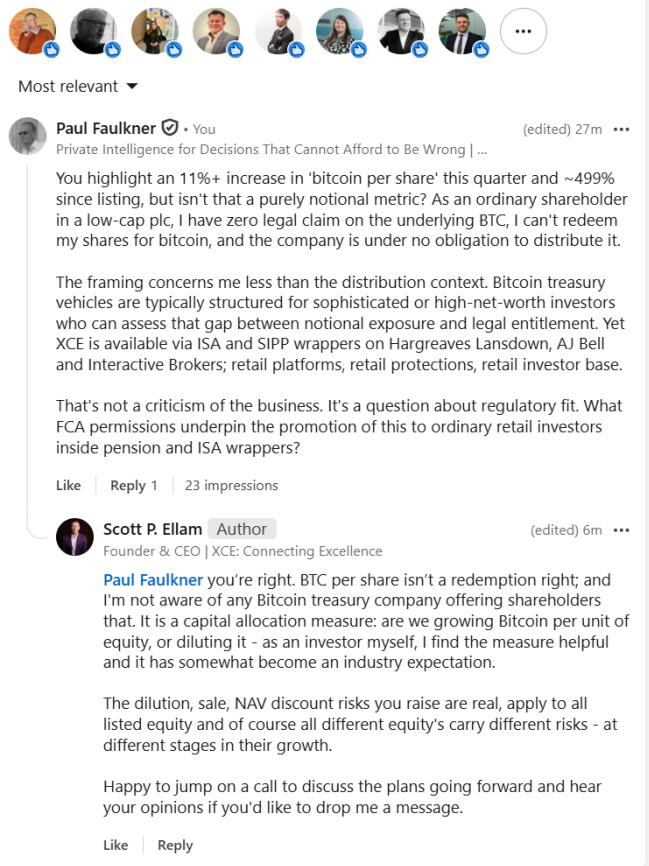
CEO Scott Ellam — Public Comment — 24 April 2026 · Now Deleted
“Paul Faulkner you’re right. BTC per share isn’t a redemption right… The dilution, sale, NAV discount risks you raise are real.”
Exhibit 46 · Link02 · Captured 01:33 UTC 25 April 2026 · Deleted by 21:22 UTC 25 April 2026
Sam Roberts, Non-Executive Chairman — LinkedIn DM — 24 April 2026 · 22:37
“I am not going to comment on potentially market-sensitive or regulatory matters through LinkedIn, but I will ensure that the points you raise are reviewed through the company’s proper governance and adviser channels.”
Exhibit 56 · XCE25 · Language chosen by Roberts, not by Faulkner
Exhibit 50 · Link06 · SHA-256 Hashed Captured: 25 April 2026 · 21:22 UTC · After deletion
Screenshot of deleted CEO comment — Exhibit 50, Link06
Deleted
Comment removed by CEO Scott Ellam
25 April 2026 · between 01:33 and 21:22 UTC
Original promotional post left live
Act 3 — The False Explanation · CEO Scott Ellam · 26 April 2026 · Public Reply
“For transparency: I deleted my response as it was made against an earlier version of your comment prior to your edit — LinkedIn doesn’t notify of edits.”
Exhibit 65 · Link12 · Posted publicly 26 April 2026, ~16:11 UTC — 48 hours after deletion
Why the defence is false — the documentary record
The deleted reply is a substantively correct, paragraph-by-paragraph response to the comment as it currently stands. Faulkner asks about BTC per share as a notional metric — Ellam answers “BTC per share isn’t a redemption right.” Faulkner asks about dilution and NAV discount risk — Ellam answers “those risks are real.” For the defence to be true, Faulkner would have had to edit the comment to be more aligned with Ellam’s reply, after the reply was already posted. That is operationally absurd. LinkedIn provides no extractable edit history to either party. The asymmetry is forensic discipline: Faulkner’s profession produces timestamped captures; the capture at 25 April 01:56:26 UTC shows no (edited) marker on the comment. Ellam, a recruitment consultant, preserved nothing on his side. The Non-Executive Chairman acknowledged in writing that the matters were “potentially market-sensitive or regulatory.” The promotional post, remained live throughout.
Exhibits 45, 46, 50, 65, 67 · Link01, Link02, Link06, Link12, Link14

A CEO making and publicly retracting material risk disclosures, then making a false public statement to explain the retraction, is conduct the FCA’s Senior Manager and Conduct rules contemplate directly.

From the investor presentation.
Set against the Company’s own documents.

On 16 April 2026 CEO Scott Ellam and CFO Angus Gladish hosted a recorded investor presentation. The following findings are each set against the Company’s own contradicting documents. All quotations verbatim from source.

Finding 01 · Investor Presentation Material False Guarantee

The mNAV Floor Guarantee — “positive MNAV at all time”

CEO Scott Ellam, Investor Presentation 16 April 2026: “the profitable operations hold the MNAV that I referred to earlier as floor so if you imagine an EBITDA multiple in our industry times six is quite common for the PLCs that allows us to be at a positive MNAV at all time allowing capital raised to always be accretive if converted immediately into bitcoin.”

The claim: the operating business creates an EBITDA-multiple floor that mathematically prevents mNAV from going negative. Positive mNAV “at all time.”

Contradicting document — Exhibit 13, RNS13, Interim Results, 26 March 2026: Group EBITDA for H1 FY2026 was a (£54,000) loss, including £806,800 IPO exceptional. An EBITDA-multiple floor cannot mathematically support a positive mNAV when the multiplicand is negative. This was filed three weeks before the presentation.
Finding 02 · Investor Presentation COBS 4 Financial Promotion

The 30% Bitcoin CAGR Projection + “always going to go up”

CEO Scott Ellam, Pt2: “we believe we’ll see a base case of a 30% compound annual growth when you look back over the next 10 years.” Later in the same segment: “I believe the Bitcoin price is always going to go up over the long term and it will certainly, as a base case, always be worth more than it has been in the past.”

A 30% base-case CAGR projected as an absolute in a recorded financial promotion to retail investors holding tax wrapper investments.

Contradicting document — Exhibit 17, RNS17: The Company’s own RNS filings carry the disclosure “the financial regulator in the UK (the Financial Conduct Authority or FCA) considers investment in Bitcoin to be high risk.” The CEO presents a categorical, time-unbounded directional view of Bitcoin to that same retail audience. COBS 4.5 governs quantified forward-looking statements in retail-directed financial promotions.
Finding 03 · Investor Presentation Absolute Safety Claim

The Bond Safety Claim — “those bonds are very safe”

CEO Scott Ellam, Pt1: “Those bonds are very safe and offer upside for the investors, the business and the bond buyers.”

The XCE BTC-denominated convertible bond has an issuer refix option that allows the conversion price to be lowered if the share price falls. The first tranche subscribers include institutional investors and strategic investor Adam Back.

Contradicting document — Exhibit 8, RNS08: The bond is structured to transfer dilution risk from sophisticated bondholders (Adam Back, institutional investors) to retail equity holders. “Very safe” from the bondholder’s perspective is the opposite of what it means for the equity holder, who absorbs the entirety of BTC price risk, dilution risk, and premium-compression risk.
Finding 04 · Investor Presentation Selective Conflict Disclosure

Cartwright Credential Without Conflict — the Chairman’s role presented as bona fides

CEO Scott Ellam, Pt1: “There’s also Sam Roberts our chairman. Sam is director investment consulting at Cartwrights. He led the first British pension fund allocation to bitcoin in recent years.”

Roberts’ Cartwright role is presented as a credential — bitcoin pension expertise, professional standing. What is not disclosed in the same breath: Cartwright is XCE’s paid BTC liquidity provider and Custodian Adviser. Roberts’ director fees and warrants are paid to Cartwright. Cartwright is omitted from the public Advisors page.

Contradicting documents — Exhibit 22, p.10, p.21, p.23: The Cartwright Agreement of 4 July 2025 is a material commercial contract in force. The credential is presented without the related-party fact pattern that defines it.
Finding 05 · Investor Presentation Selective Financial Framing

Subsidiary Operating Profit — Group EBITDA loss omitted

CEO Scott Ellam, Pt1: “1.2 million group revenue for the period, net fee income up 20 percent to 0.9 million between 1st July and 31st of December and a 0.78 million group gross profit with a 0.34 million operating profit for the flagship operating business Spencer Riley.”

The relevant aggregate for Group shareholders is the Group result. The subsidiary’s operating profit is cited. The Group EBITDA is not.

Contradicting document — Exhibit 13, RNS13: The Group’s EBITDA for the same period was a (£54,000) loss. Neither the CEO nor the CFO stated the Group H1 EBITDA figure during the presentation.

The dashboard says £21/day.
XCE’s own dashboard. Five errors. 375× gap.

The complete Aquis trade tape — 195 trades across 56 trading days, 2 January to 24 April 2026. The Company’s own analytics dashboard reports average daily trade value of £21.30 and average daily volume of 1,390 shares. Forensic reconciliation against the Aquis trade tape identifies five distinct errors in the dashboard. The worst: the “Average Daily Trade Value” is not a daily average at all — it is the mean size of an individual filtered retail trade (sub-£47), mislabelled as the daily total. Actual active-day average: £7,988. Understatement: 375×. The same methodology appears on the OTCQB Venture Market display (XCELF), which also reports approximately 1,400 average daily volume. Both figures exclude 89.4% of total market volume. The three charts below make the gap, the filter, and the RNS pattern visible. No inferences are drawn beyond what the timestamps support. The pattern warrants scrutiny under MAR Article 8. The inference is for the regulator.

Exhibit · Chart 01 · Aquis Tape vs Dashboard Metric
→ Finding: 375× liquidity misrepresentation — £21.30 claimed, £7,988 actual
The Company’s analytics page reports average daily trade value of £21.30 and average daily volume of 1,390 shares. The complete tape shows £7,987.51 and 420,860 shares per day. Chart 2 explains why: the dashboard metric filters to a sub-population of trades that excludes every block print.
Exhibit · Chart 02 · All 195 Trades by Size — Retail vs Block
→ Finding: 60 block trades (>100k shares) = 89.4% of all volume — entirely excluded from the dashboard metric
Each dot is a trade. Log scale on the Y axis. The red dots are block trades above 100,000 shares — 60 of them across the dataset. The horizontal line marks the 100,000-share threshold. The dashboard “average daily trade value” metric is calculated from a filtered view that sees only the bottom band. The block trades — which constitute the majority of total value — are excluded from the metric presented to retail investors.
Exhibit · Chart 03 · Block Trades vs RNS Announcement Dates
→ Finding: concentrated block activity at T−1 and T across 7 RNS sessions — including the 4M-share matched-pair on 29 January (no RNS context)
Vertical lines mark RNS announcement dates. Red dots are trades occurring on the day of, or the day before, each price-sensitive RNS filing. Grey dots are all other trades. The clustering of block prints in RNS windows — particularly the 350,000-share print at 16:32 on 22 April (T−1 to the Adam Back dual-RNS release) and the 569,285-share print at 08:37 on 23 April (first post-announcement print, the largest GBP-value trade in the dataset) — is the pattern that warrants regulatory examination under MAR Article 8 and MAR Article 14.
29 January 2026 — The Matched-Pair Anomaly (Largest Day in Dataset)
TimePrice (GBX)VolumeValue (GBP)Note
10:302.150033,070£711.01
10:342.05002,000,000£41,000.00Matched-pair leg 1 — same minute, same price, same size as leg 2
10:342.05002,000,000£41,000.00Matched-pair leg 2 — identical in every respect to leg 1
11:002.100050,000£1,050.00
11:002.100050,000£1,050.00
11:372.000112,500£250.01
11:592.0000150,000£3,000.00
13:482.03491,622£33.01
Day total: 4,297,192 shares, £88,094.03 — the largest day in the dataset by both volume and value. Two 2,000,000-share prints at 10:34 priced identically at 2.05 GBX (£41,000 each) — same minute, identical price, identical size. No published RNS within ±2 trading days. The matched-pair structure recurs: 21 January 16:03 (894,409 + 896,400 shares, same minute, near-identical price); 29 January 11:00 (50,000 + 50,000 shares, identical price). This structure is consistent with crossed off-book trades reported through the venue feed, principal hedges by the market maker, or related-party crossed trading. Resolution requires the venue’s surveillance records.
22 April 2026 — Pre-Announcement Detail
TimePrice (GBX)VolumeValue (GBP)Note
08:391.6010,845£173.52
11:121.525170,378£2,598.26
12:581.89211,272£3,993.04
13:041.862252,760£993.05
16:321.80350,000£6,300.00Largest 22 Apr print. At or immediately after formal close. 375× the dashboard avg daily value.
07:00, 23 April 2026 — Two Simultaneous RNS Releases
RNS17
Bitcoin Acquisition. XCE announces purchase of 10 BTC for £585,500.
RNS18
XCE secures further investment from Adam Back. 33,457,143 new shares at 1.75p. Gross proceeds: £585,500. Use: entirely to fund the 10 BTC purchase in RNS17.
23 April 2026 — Post-Announcement Detail
TimePrice (GBX)VolumeValue (GBP)Note
08:371.99569,285£11,328.77Largest single GBP-value trade in full dataset. +10.6% from 22 Apr close.
08:532.0025,000£500.00
09:472.1951,139£25.00
09:552.19522,551£494.99
11:402.187520,253£443.03Intraday high: +22.0% from 22 Apr 16:32 reference.
Data establishes: 350,000-share print at 16:32 on 22 April — 375× the dashboard average daily value — immediately before two simultaneous price-sensitive RNS releases at 07:00 the next morning. First post-announcement print: 569,285 shares at 1.99p, largest GBP-value trade in the dataset. Price movement: +22.0% from the 22 April 16:32 reference. Across at least seven RNS-relevant sessions in the 113-day window, block trades concentrate in the immediate temporal vicinity of price-sensitive announcements. The 29 January matched-pair (4M shares, £82,000, two equal legs at identical price and time, no RNS context) is separately anomalous. The Company’s dashboard methodology renders every one of these trades invisible to retail investors by reporting the mean size of an individual sub-£47 trade as the “Average Daily Trade Value.” Applicable provisions: MAR Articles 8, 14, and 16. Primary surveillance obligation: Aquis Stock Exchange. Competent enforcement authority: the Financial Conduct Authority. The inference is for the regulator.

The complete
40-page report.

70 exhibits. SHA-256 hashed. Five dashboard errors. The CEO admission. The deleted screenshot. The false explanation. The full trade tape with matched-pair analysis.

Free · No paywall · Institutional and retail readership

Full 25-page reportThe complete forensic analysis — all 12 sections, all findings, full document control log
70-exhibit evidence baseThe complete master evidence log — RNS01–21, XCE01–31, Link01–17 — hashed and indexed
The full LinkedIn sequenceExhibit 46 (admission), 50 (screenshot), 65 (false explanation), 67 (refutation) — all 17 captures
Retail investor sectionPlain English. What you actually own. The exit arithmetic.
    Institutional distribution

    Report is also distributed directly to Aquis Stock Exchange (market integrity), the Financial Conduct Authority (regulatory action), and institutional allocators evaluating XCE. Press enquiries: contact via paulfaulkner.com/contact/

    Three share counts. Two contradictory volumes.
    No offer to sell at any price.

    Finding A — Third share count
    OTCQB shows “Shares Out: 382,165,687” — the 31 December 2025 figure, not updated for the 23 April Adam Back subscription (+33.5M shares). Three different share counts across three public surfaces. The OTCQB market cap is internally consistent but uses the wrong (pre-Adam-Back) share count.
    Finding B — Same mislabelled metric
    OTCQB reports “Average Vol (300): 1,400.” The mNAV.com dashboard reports 1,390. Two different venues. Two different averaging windows. Both arrive at ~1,400 — consistent with a shared methodological provenance: the same mislabelled metric (mean trade size of filtered retail trades) deployed across both venue displays.
    Finding C — Internal contradiction on same page
    The OTCQB Quote page shows two different “average daily volume” figures on the same page: “Average Vol (300): 1,400” in the main panel and “Avg. Daily Share Vol: 5,600” in the Short Interest panel. A user cannot determine which is the real average. Neither is reproducible from the displayed trade data.
    Finding D — Functionally dead market
    Two trades visible in the most recent OTCQB window. Best Ask: “0.00 / 0” — no offer to sell at any price at the moment of capture. A US-domiciled retail investor cannot buy XCELF at any price. The 52-week range: $0.0269–$0.03. Dual-listed. One venue functional. One venue not.
    Summary: A retail investor anywhere in the world consulting XCE’s public surfaces — Companies House, AQSE, OTCQB, xce.io, mNAV.com — encounters at least three different share counts, two different “≈1,400” daily-volume figures contradicted by their own underlying tapes, and four stale price snapshots embedded across the AQSE-side dashboard. No two surfaces tell the same story about the same security. [Exhibits 61, 62 — XCE30, XCE31, OTCQB pages captured 26 April 2026]

    What you actually own.

    You own a share of a Leeds executive recruitment company called Spencer Riley, wrapped inside a holding company called Connecting Excellence Group PLC, which holds 62.93 Bitcoin as treasury reserves. The recruitment company produced approximately £175,000 of operating profit in the year before listing. The Group, in its first half-year as a listed PLC, reported a £54,000 EBITDA loss.

    You do not own Bitcoin. The Company itself confirms this in every Bitcoin-related RNS: “an investment in the Company is not an investment in Bitcoin, either directly or by proxy.” The CEO confirmed it directly in a public comment before deleting it: “BTC per share isn’t a redemption right.” You have no legal claim on the underlying BTC. You have no right to redeem your shares for Bitcoin.

    You bought a share that, at the price you paid, is approximately 2.72x the value of the Bitcoin the Company holds — not the 2.53x the Company’s dashboard displays. For Bitcoin to rise far enough to recover that premium, BTC would need to appreciate approximately 177% from your entry price, not 153% as the dashboard implies. The Bitcoin NAV displayed on the dashboard (£4.00M) is overstated by 11% — actual Bitcoin NAV is £3.60M. Both errors work against you and neither is disclosed as an error.

    The Company’s own analytics dashboard shows “Average Daily Trade Value: £21.30.” Forensic reconciliation of the full Aquis trade tape shows the actual active-day average is £7,988 — 375 times larger. The dashboard figure is not a daily average. It is the mean size of an individual filtered retail trade (the 38 smallest trades, all under £47) mislabelled as the daily total. Every block trade — 60 trades representing 89.4% of total volume — is excluded from that metric. The retail-accessible market (trades under 10,000 shares) totals £3,779 in value over four months. If you wish to exit a £2,500 position, you represent more than 100 days of total retail-accessible trading. The “exit” your platform’s “sell” button implies does not exist at any meaningful position size.

    You are protected by neither the Financial Ombudsman Service nor the Financial Services Compensation Scheme on the Bitcoin component of this investment. You should read the Important Notice block at the foot of every XCE Bitcoin RNS. You should read the Risk Factors section of the Admission Document. You should compare those documents to the analytics page and the 16 April 2026 investor presentation. The two sets of documents tell different stories about the same security.

    This report does not constitute investment advice. You may wish to speak to an FCA-authorised financial adviser before making further decisions about this holding.